
20 KiB
Getting Started with NSPanel HA Blueprint
Welcome to this setup guide, a community-driven approach to integrating NSPanel into your smart home. Designed for users at all levels, it combines Home Assistant's user-friendly interface with ESPHome's customization options.
Whether you're a first-time smart device user or an enthusiast looking to personalize your setup, this guide provides the necessary tools and instructions. Let's embark on creating a smart home that's uniquely yours.
Note
Some images or instructions on this guide might be slighly different due to different configurations depending on your ESPHome and Home Assistant implementation or versions.
If you find something that is not understandable or needs to be updated, please let us know. You can create an issue reporting this, or fix it yourself and submit a Pull Request to this repository.
Summary
- Preparation
- ESPHome Firmware
- Upload TFT
- Blueprint
- How to Handle Multiple Panels
- Advanced Configuration for ESPHome and Home Assistant Experts
- Additional Tips and Resources
Preparation
Start by ensuring you have all the necessary tools and files. This includes your NSPanel device, a stable internet connection, and access to your Home Assistant instance.
If flashing it for the first time, please look for additional preparation and tools on the Flashing the device for the first time section later in this guide.
ESPHome Firmware
Preparing the ESPHome Environment
To flash your NSPanel, ESPHome firmware is required. ESPHome can be integrated into your setup in various ways, including as a Home Assistant add-on or through a local installation on your computer. This guide is based on using the ESPHome dashboard, which is available in all standard implementations.
-
Installing ESPHome as a Home Assistant Add-On: For seamless integration with Home Assistant, ESPHome can be installed as an add-on. This method provides an easy-to-navigate interface and direct integration with your Home Assistant setup. For detailed instructions on this installation method, refer to Getting Started with ESPHome and Home Assistant.
-
Manual Installation of ESPHome: A manual installation on your computer might be preferred if your Home Assistant's host is resource-limited and struggles with compiling ESPHome projects. Standalone installations on a normal computer typically offer faster and more efficient compiling. This method is ideal if you're working with a system that doesn't support Home Assistant add-ons or if you prefer a separate management environment for your ESPHome devices. Detailed steps for a manual installation can be found in the guide Installing ESPHome Manually.
Setting Up a Device on ESPHome Dashboard
Follow these steps to add a new device in the ESPHome Dashboard:
-
Click the + New Device button.
-
Enter a unique name for your new ESPHome device.

-
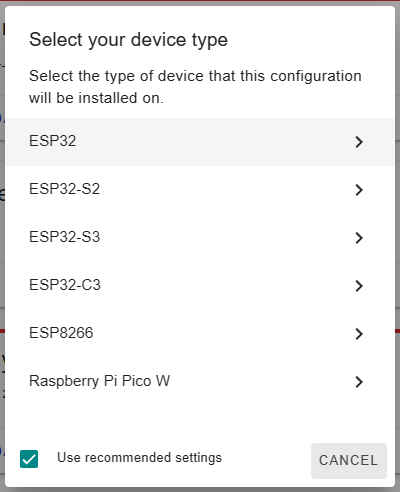
Select ESP32 as the device type.
-
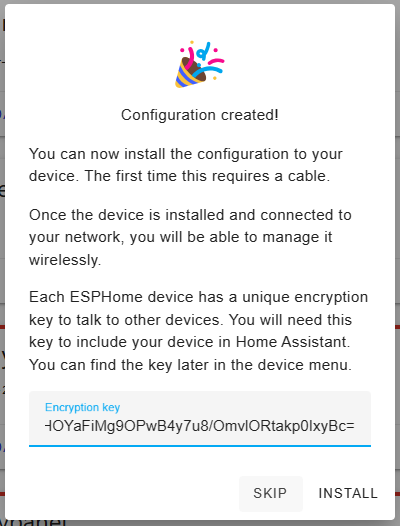
Click Skip as we're not starting the installation yet.
-
Locate your newly created device in the ESPHome Dashboard and click Edit.

-
(Optional) For enhanced security, consider copying the
api:section to a temporary file.

-
Note the device name at the beginning of the file under
esphome.

-
Clear all existing content and paste the following YAML configuration:
substitutions:
  # Settings - Editable values
  device_name: "YOUR_NSPANEL_NAME"
  wifi_ssid: !secret wifi_ssid
  wifi_password: !secret wifi_password
  nextion_update_url: "http://homeassistant.local:8123/local/nspanel_eu.tft"
  # Add-on configuration (if needed)
  # heater_relay: "1"  # Possible values: "1" or "2"

# Customization area
##### My customization - Start #####
##### My customization - End #####

# Core and optional configurations
packages:
  remote_package:
    url: https://github.com/Blackymas/NSPanel_HA_Blueprint
    ref: main
    files:
      - nspanel_esphome.yaml # Core package
      # Optional advanced and add-on configurations
      # - advanced/esphome/nspanel_esphome_advanced.yaml
      # - nspanel_esphome_addon_climate_cool.yaml
      # - nspanel_esphome_addon_climate_heat.yaml
      # - nspanel_esphome_addon_climate_dual.yaml
    refresh: 300s

esp32:
  framework:
    type: esp-idf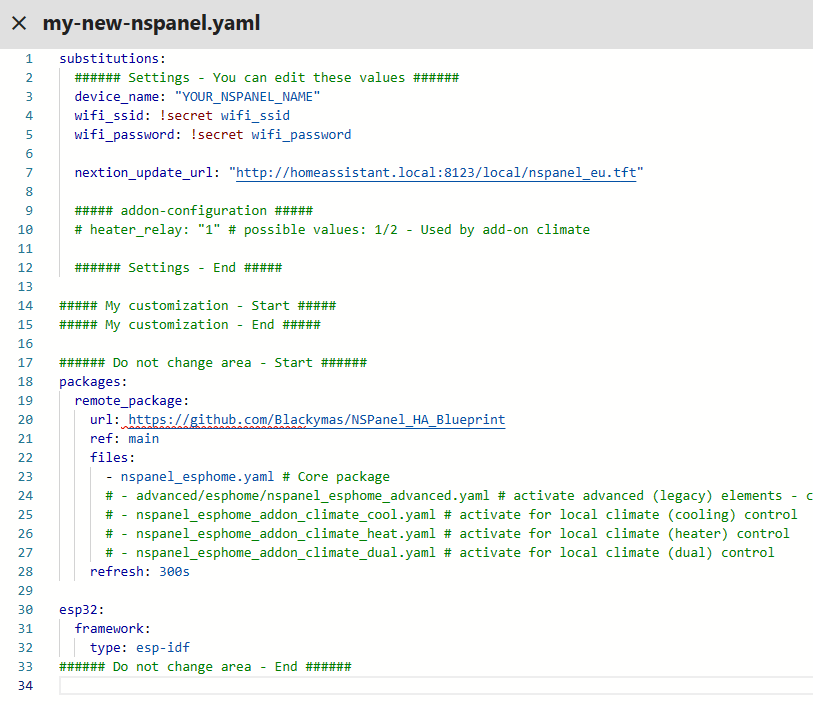
-
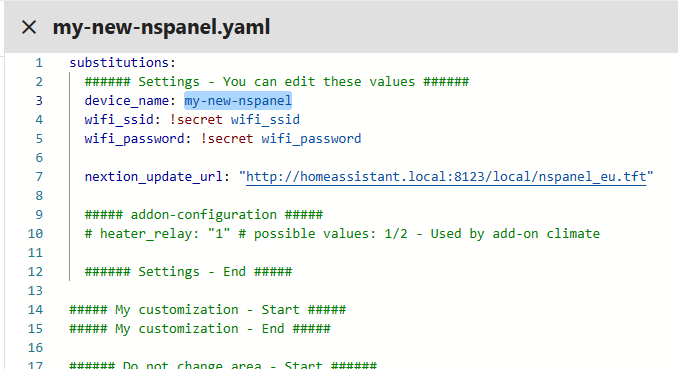
Modify the Settings section with your device name (as noted in step 7) and Wi-Fi details.
-
For Wi-Fi credentials, use
!secretfor added security or input them directly. Learn about secrets in ESPHome: Home Assistant Secrets in ESPHome. -
Optionally, adjust
nextion_update_urlto the URL of a TFT file hosted on an HTTP or HTTPS server, ensuring that the file is accessible to the NSPanel. This URL will be used by ESPHome to download the TFT file to your panel. For more information on hosting the TFT file and setting up the URL, see the Upload TFT section. -
(Optional) Enhance security with API encryption by adding the copied key from step 6 to the My Customization area.
-
After finalizing settings, click Save and close the YAML window.


Your NSPanel is now configured in your ESPHome Dashboard.
Flashing the Device for the First Time
Drive Safe
Caution
Disconnect your panel's controller module from main power during all work.
Operating on an open device that's plugged into the wall puts you at risk of electrocution.
Warning
You are solely responsible for your own safety.
If you're uncomfortable or if something feels wrong, stop immediately.
- Use only electronic components rated for 3.3VDC. Ensure your TTL adapter is set to 3.3VDC. Exceeding this voltage can cause permanent damage to your panel.
- Maintain a clean work area to prevent damage to your device, especially the screen.
- Keep all small parts, like screws and cables, safely stored.
Required Tools
For first-time flashing of your NSPanel with ESPHome, you may need:
- USB-to-Serial TTL adapter
- Jumper wires
- Breakable headers (optional)
- Appropriate screwdriver to disassemble your panel's controller module (touch plate)
Connecting Your Device via USB-to-Serial TTL Interface
Before disassembling your panel, review the following resources:
- YouTube - Mark Watt Tech - HOW TO - Setup the SIMPLEST Smart Home Scene Controller
- @blakadder's Sonoff NSPanel EU Switch in Detail
- ESPHome - Physically Connecting to Your Device
Pending: (Pictures of the board & wiring will be added here) Pending: (Steps to generate firmware on ESPHome Dashboard will be added here) Pending: (Steps to flash the firmware using serial TTL will be added here)
Integrating your panel to Home Assistant
Once your panel loaded the new ESPHome firmware, it should be automatically detected by Home Assistant and you should get a notification about that. If that isn't happnening, you can manually add it as a new intgration with the following steps:
Tip
You can use this link to go directly to the dialog to add a new ESPHome device, then you can go directly to step 3.
- Go to your ESPHome integration's page under Settings > Devices & Services > ESPHome.
- If your panel is automatically discovered, just click Configure, otherwise, click on Add device.
- Enter your new panel's hostname or IP address and click Next.
- Follow the instructions from your Home Assistant to add your new panel.
After that, you will have access to the Device's page related to your NSPanel. On that page you will find all the entities published by the ESPHome firmware installed in your panel, which can be use to see it's status and control some of it's settings.
It might take a minute or two until the device's page gets fully populated, but when that is completed, take a look around and get familiar with that page.
You can always get back to the device's page under your ESPHome integration's page.
Making changes Over The Air (OTA)
Pending: (add instructions how to flash wirelessly)
Updating
Pending: (add instructions how to flash wirelessly) Pending: (considerations - update all to the same version)
Migrating from other custom firmware
The installation in a NSPanel with Sonoff's original firmware should be straighforward, however, if you have installed some other custom firmware before, you may have additional steps to execute.
NSPanel Lovelace UI
If you have already installed on your NSPanel the "nspanel-lovelace-ui" firmware from @joBr99 or from Tasmota, an intermediate step is necessary. Please execute that first before returning here.
Other
Please try the standard process and if you find any issue, please create a new issue and inform which custom firmware you have installed before migrating to NSPanel HA Blueprint.
Upload TFT
Pending:
Select the right file
Open the device's page under ESPHome integration's page and look for Update TFT display and Update TFT display - Model under the Configuration area.

Expand the Update TFT display - Model control and find the model that better fits your panel:

The options are:
- Use
nextion_update_url: This will indicate ESPHome to download the TFT file from the URL you specified in your panel's yaml setting under the ESPHome dashboard and is typically used when your device have issues to transfer a TFT file directly from the GitHub repository or when you want to use a custom TFT file hosted in your local server. This is the default option and this keeps the compatibility with legacy installations when this was the only option. - NSPanel Blank: This is a very small TFT file which just shows a pre-formatted QR code on the screen with a link to the instructions. Although it's not a functional TFT for controlling your panel, it can be usefull when you have issues in your first TFT upload, as it will remove the Nextion Active Reparse Mode used when a Sonoff's TFT and also when some other custom implementations are installed.
- NSPanel EU: This should be used when you are using a Sonoff NSPanel EU model.
- NSPanel US: This should be used when you are using a Sonoff NSPanel US model installed on it's normal (portrait) position with the buttons bellow the screen.
- NSPanel US Landscape: This should be used when you are using a Sonoff NSPanel US model installed on the landscape position with the buttons at the right side of the screen.
- NSPanel EU (CJK languages): This should be used when you are using a Sonoff NSPanel EU model and want to use the CJK (Chinese/Japanese/Korean) languages.
- NSPanel US (CJK languages): This should be used when you are using a Sonoff NSPanel US model installed on it's normal (portrait) position with the buttons bellow the screen, and want to use the CJK (Chinese/Japanese/Korean) languages.
- NSPanel US Landscape (CJK languages): This should be used when you are using a Sonoff NSPanel US model installed on the landscape position with the buttons at the right side of the screen, and want to use the CJK (Chinese/Japanese/Korean) languages.
Uploading to Nextion
Once the right model is selected, please press the button Update TFT display.
In a few seconds your display should start transferring the file correspondent to the selected model. The transfer screen shows a progress bar with a percentage counter with a black background.
If the transfer don't starts in a few seconds, ESPHome will retry automatically a few times, with different transfer parameters, so the transfer can take up to a minute to start.
Once started, the transfer shouldn't take more than 10 to 20 minutes. If after this time it isn't close to finnish, please cancel the process by restarting your device, then try it again.
Tip
For troubleshooting TFT transfer issues, consult our TFT Transfer Troubleshooting Guide first.
Troubleshooting TFT transfer issues
We have an useful guide for troubleshooting TFT transfer issues. Please take a look there.
Blueprint
This section provides guidance on importing the NSPanel HA Blueprint from our GitHub repository into your Home Assistant, creating a new automation for your panel setup, and updating the blueprint when new versions are available. These processes are straightforward with the latest versions of Home Assistant. If you have any questions or need clarification, please reach out to us.
Importing the Blueprint
Importing the blueprint into Home Assistant is a simple process. Just click the button below and follow the steps:

Creating an Automation
After importing the Blueprint into Home Assistant, create a new automation using these steps:
- Go to Settings → Automations & Scenes → Blueprints in Home Assistant.
- Find the NSPanel Configuration Blueprint and click on it.
- In the Blueprint settings, select your panel in the NSPanel device field.
- Complete the relevant settings and click the Save button.
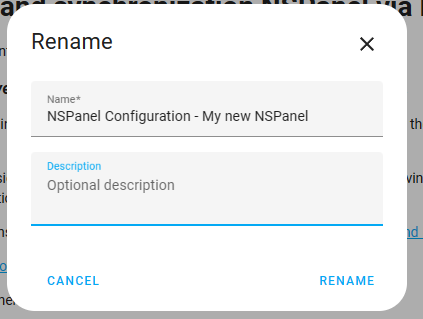
- Name your automation for easy identification and click Rename.

Tip
For a comprehensive list of panel settings, refer to the Blueprint Guide.
Editing Automation Settings
You can modify your automation anytime to change configurations:
-
In Home Assistant, go to Settings → Automations & Scenes. Or use the link below.

-
Find your automation in the list and click on it to edit.
-
After making changes, click Save. The new settings will be sent to your panel, usually within seconds. Some changes may require a page reload on the panel to appear.
Tip
For a comprehensive list of panel settings, refer to the Blueprint Guide.
How to Handle Multiple Panels
For homes with multiple panels:
-
Repeat the steps in the "Blueprint" section for each panel.
-
Ensure each panel has a unique entry in the ESPHome Dashboard and in Home Assistant under Settings → Devices & Services → ESPHome.
-
Create a separate automation for each panel in Home Assistant.
Important
Avoid assigning the same panel to multiple automations. This can cause unexpected behavior and put extra load on Home Assistant and your Wi-Fi network. Currently, Home Assistant does not have a mechanism to prevent this.
Advanced Configuration for ESPHome and Home Assistant Experts
Warning
Customizations and advanced mode are not supported by this project's team. Use them with caution and only if you have the necessary expertise.
Before customizing your system, we encourage you to share any enhancements you make.
Consider creating a Pull Request to the dev branch to share your discoveries with the community.
Advanced ESPHome Configuration
For advanced customization with ESPHome, start with "Customizations." We have a dedicated page for this, and your contributions are welcome: Customization.
To use a local copy of nspanel_esphome.yaml, copy the file from GitHub to your local file system and include it in your ESPHome settings as follows:
substitutions:
  # Editable settings
  device_name: "YOUR_NSPANEL_NAME"
  wifi_ssid: !secret wifi_ssid
  wifi_password: !secret wifi_password
  nextion_update_url: "http://homeassistant.local:8123/local/nspanel_eu.tft"
  # Add-on configuration
  # heater_relay: "1" - possible values: 1/2

##### My customization - Start #####
##### My customization - End #####

packages:
  local_package: !include packages/nspanel_esphome.yaml

esp32:
  framework:
    type: esp-idf
Note
A sub-folder is recommended to prevent the file from being added as an additional device in the ESPHome dashboard. Alternatively, you can name the file starting with
.to exclude it from the device list.
Advanced Blueprint Configuration
The Blueprint file nspanel_blueprint.yaml can be installed manually.
You can also edit your local copy of the Blueprint, but be aware that reloading the Blueprint from the repository will overwrite local changes.
Advanced TFT File
All .HMI files used in this project are available in our GitHub repository.
Modify these files using the Nextion Editor and create your own .tft files for your device.
For guidance on using Nextion, refer to:
Additional Tips and Resources
Tip
For troubleshooting TFT transfer issues, consult our TFT Transfer Troubleshooting Guide first.
If problems persist after troubleshooting, visit the Issues page. Feel free to create a new issue for personalized assistance, providing details such as:
- A description or picture of what is displayed on your screen.
- Information on whether you are updating from a previous version of this project, migrating from another NSPanel customization, or customizing a panel with the original Sonoff settings.
- ESPHome logs from the start of your panel to the point where the upload fails.
- A description of what you have already tried.
Important Note
Remember, these instructions serve as a guideline and may vary based on your specific setup and any systems previously installed.